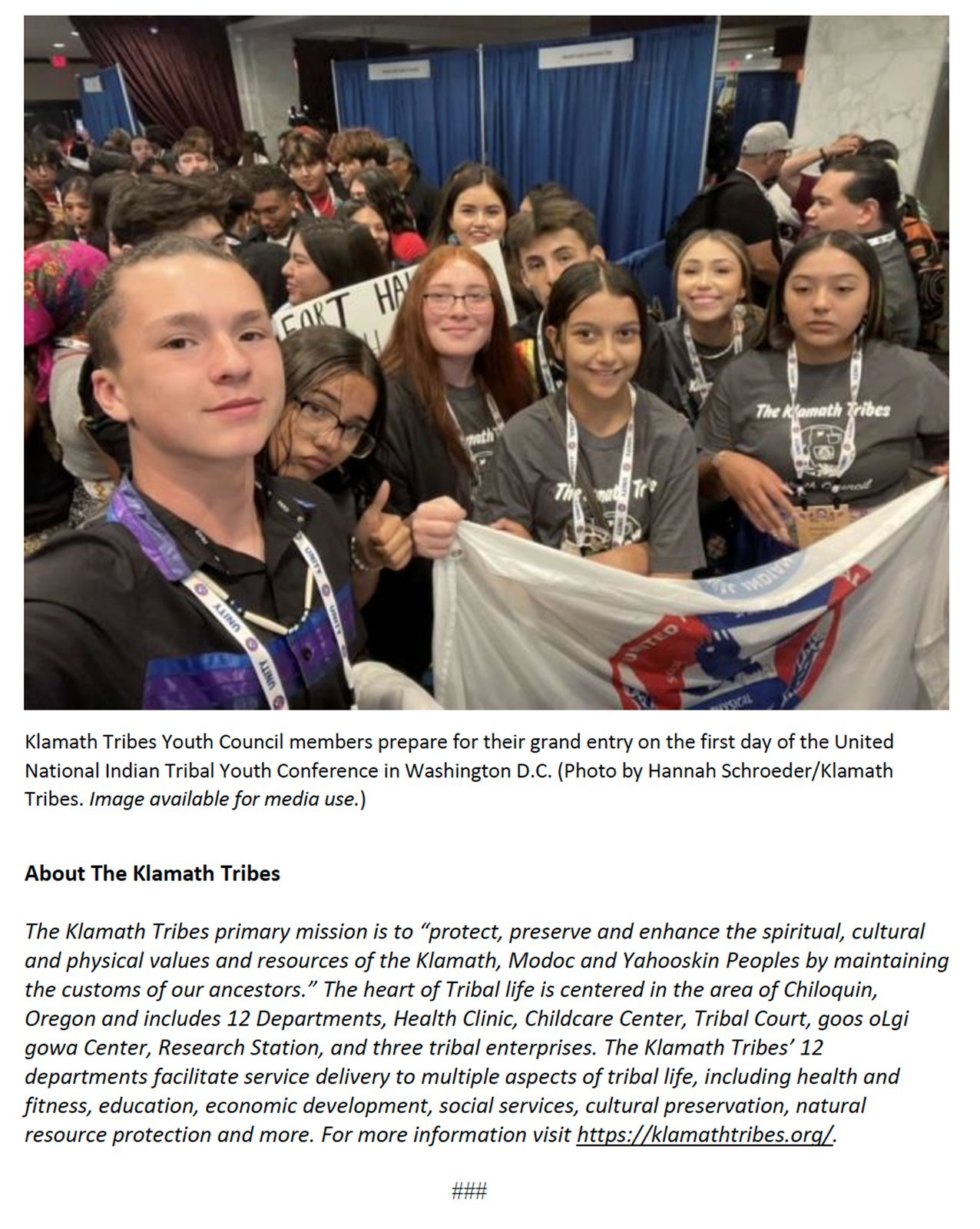
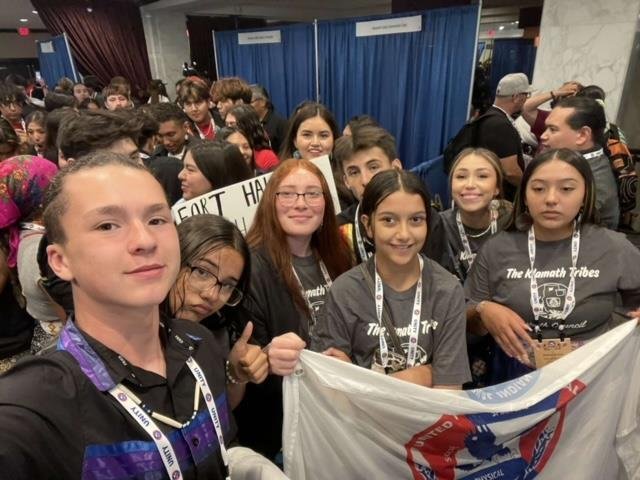
CHILOQUIN, Ore. — Members of the Klamath Tribes Youth Council spent 10 days in the Nation's Capital attending the United National Indian Tribal Youth, Inc. (UNITY) conference.
One of the tribal youth attending was Maggie Hicks — who provided a summary of some of their activities on their trip.
Tuesday, June 27 — Meetings, Tours, and the First Memorial Visit
We started our day by attending a meeting with Senator Wyden's staff and talked about our Sticker Shock Program and some working conditions and language learning.
We then headed to meet with Morgan Saunders from Native American Rights Fund (NARF) — where we toured their new building and met student interns. We talked about how NARF can benefit our tribe and other tribes. We learned that they would love to help youth get into law school and assist in our college applications.
That kind of one-on-one access to a national-level Native legal-advocacy organization is exactly the value of UNITY conference participation — it builds the relationships that turn into law-school applications, scholarships, internships, and eventually working lawyers serving Tribal Nations.
Sightseeing — Day 1
We then started our sightseeing. Our first stop was the National Museum of the American Indian — where we viewed artifacts from indigenous tribes all over the country and saw walnut dice from our people.
Finding artifacts specifically representing the Klamath Tribes at the national museum is meaningful — recognition that our people's history is part of the national story being told.
We then made our way to the Lincoln Memorial — where we took pictures and practiced our dance to share at UNITY's cultural night.
We then made our way back to the hotel to rest and prepare for an early start to our next day's activities.
Wednesday, June 28 — Oregon Congressional Meetings, Holocaust Museum, the White House
We met with Congresswoman Suzanne Bonamici's staff and discussed:
- The Sticker Shock Program
- Restoring natural diet and health
- Helping with mental and physical needs
We then headed to the next meeting where we met with Congresswoman Andrea Salinas's staff and talked about:
- Sticker Shock
- Water rights
- The impact of cows on river banks
- The need for Sovereignty
- The shortage of staff in our medical facility
Those topics — water rights, sovereignty, healthcare access — are the central, ongoing issues facing the Klamath Tribes and many Tribal Nations. Having Youth Council members carry those messages directly to Oregon's Congressional delegation is real political education in practice.
The Holocaust Memorial Museum
Next, we visited the Holocaust Memorial Museum where we learned from beginning to end about this tragedy and the things Jewish people went through.
That visit — and the parallels Native youth might draw between the Jewish Holocaust and the genocidal policies enacted against Native Peoples in U.S. history — is part of the broader education that UNITY participants receive about justice, advocacy, and the dignity of remembering.
The White House
We then went to the White House and took pictures. Our tribal chaperones Hannah Schroeder and Shayla Ochoa sang one of our traveling songs in front of the White House.
Singing a traditional Klamath traveling song in front of the White House — on the lawn of a building that has historically been the seat of policies that harmed Native Peoples — is itself an act of cultural reclamation and resilience.
Thursday, June 29 — Monuments and the Pre-Conference
We started the day by sightseeing — we went to the Washington Monument, and from there we walked down to the Veteran Memorial.
Then we made our way back to the hotel to get ready for the pre-conference.
The Pre-Conference
During the pre-conference, we:
- Participated in a healing circle
- Split off into groups and talked about problems in our community and who we could go to and talk to about these problems
- Played icebreakers and said what we were grateful for
We then ended our day.
That structure — healing circle + community-problem-solving + relationship-building — is exactly the kind of programming UNITY does so well. It's not just professional development for Indigenous youth; it's holistic preparation for the work of being a Tribal Nation leader.
What the Trip Built
A ten-day trip to D.C. for Indigenous youth produces compounding benefits:
- Direct exposure to national-level Tribal advocacy organizations like NARF
- Personal relationships with Oregon Congressional staff (who'll remember meeting these specific kids when those kids return as adults working in their tribal communities)
- Cultural pride through performing traditional songs in iconic national spaces
- Peer relationships with Indigenous youth from across the country
- Career inspiration — for Maggie and others who might pursue law school, public-policy careers, healthcare, or tribal governance
For the Klamath Tribes specifically, every Youth Council trip like this is an investment in the next generation of Tribal leadership — kids who'll grow up to be the chairpersons, council members, attorneys, healthcare providers, and cultural carriers of their Tribal Nations.
Sticker Shock Program
The Sticker Shock Program — referenced multiple times in the Youth Council's Congressional meetings — is a youth-led initiative addressing substance abuse and underage drinking in Tribal communities.
By placing warning stickers on alcohol products at retailers and engaging youth in education and advocacy, Sticker Shock programs nationally build awareness about underage-drinking laws and the health/community impacts of substance abuse.
The fact that this is the program the Klamath Tribes Youth Council brought to Senator Wyden and Congresswomen Bonamici and Salinas as their headline initiative says something meaningful about what these youth are prioritizing.
About The Klamath Tribes
The Klamath Tribes' primary mission is to "protect, preserve and enhance the spiritual, cultural and physical values and resources of the Klamath, Modoc and Yahooskin Peoples by maintaining the customs of our ancestors."
The heart of Tribal life is centered in Chiloquin, Oregon and includes 12 Departments, Health Clinic, Childcare Center, Tribal Court, goos oLgi gowa Center, Research Station, and three tribal enterprises.
The Klamath Tribes' 12 departments facilitate service delivery across health and fitness, education, economic development, social services, cultural preservation, natural resource protection, and more.
For more information visit klamathtribes.org.
A Message of Pride
To Maggie Hicks, Hannah Schroeder, Shayla Ochoa, and every Youth Council member who made the trip to D.C.: you represented your Tribe with honor.
To the Klamath Tribes leadership that invested in sending the Youth Council: thank you for investing in the next generation.
To Senator Wyden, Congresswomen Bonamici and Salinas, and their staff: thank you for taking the meetings, listening to the youth voices, and continuing to work on the issues they brought to your offices.
The future of the Klamath Tribes is in good hands.