How Sky Lakes helped Klamath Falls win national recognition — by not taking the credit.
Go stand at the Commons on a warm afternoon and watch the water. Kids splash through the fountains. Parents lean back on the grass. Somebody's grandmother is doing laps in the shade of the new trees. Look for the name of the organization that made it possible and you won't find it — no plaque, no logo, no ribbon-cutting banner still zip-tied to a post.
That absence is not an oversight. It is a decision, and the man who runs the hospital will tell you so plainly.
"You don't see our name on a lot of those projects, and that's intentional, because we want them to be community focused," says David Cauble, president and CEO of Sky Lakes Medical Center. "Sky Lakes doesn't need to have its sign on parks downtown. It's not important to us. What's important to us is the community impact."
That instinct is what a panel of hospital leaders from across the country noticed when they named Sky Lakes the winner of the 2026 American Hospital Association's Foster G. McGaw Prize for Excellence in Community Service — the first hospital in Oregon ever to win it.
The August issue told you it happened. This is the story of who made it happen, and why it worked in a rural county of 80,000 people spread across 10,000 square miles.
The Woman Who Came The Long Way
If you want to understand how Klamath Falls won a national health prize, start with Merritt Driscoll.
Three weeks before she was supposed to graduate from Rhodes College, a car accident nearly ended everything. "I broke my arms, my legs, my neck — 11 bones," she says. "It was a life-changing experience where I learned the importance of being resilient. I felt like my life was saved, and I just had this desire to do something meaningful."
That desire took her, after a master's in public health, into the Peace Corps in Tanzania. In 2012, she and her husband moved to Klamath Falls sight unseen for his job. "We'd never been here. Actually never heard of Klamath Falls," she says, and laughs. "We moved here and fell in love with it. We think it's this hidden gem that we need to share with others."
She has spent every year since sharing it — first with Klamath Tribal Health, then at Sky Lakes' CARES child-abuse clinic, then, in 2015, with the Blue Zones Project, the effort that "really shifted the model of community health in Klamath Falls." Blue Zones later became a department of Sky Lakes and took the name it carries today: Healthy Klamath. Driscoll now leads the Sky Lakes Foundation — which means the person the McGaw jury was honoring has been quietly building this thing, program by program, for a decade.
The Man Who Chose The Smaller Room
Cauble arrived later, and from a long way off — Klamath Falls by way of Kansas City, with earlier stops in Atlanta, Birmingham, and small communities in the Carolinas and Kentucky. Ask him what surprised him about the move and he declines the premise: "Coming to a smaller community was done with intentionality."
What did stand out was what he found already here. "The level of engagement that Sky Lakes has with the community is different. It stands out from other places that I've been."
He is also blunt in a way hospital CEOs usually aren't. Klamath County's health outcomes are poor, and he says so out loud. "That's not something to be proud of, but it does recognize the fact that we've got a lot of opportunity to impact the community." The county's public-health director, Jennifer Little, now travels to other states to explain how it's done.
The Proof Is All Over Town
At the Wellness Center — the brainchild of Dr. Stephanie Van Dyke and nurse Catherine Pope, who convinced hospital leadership it was needed — more than 1,400 people a year go through lifestyle programs, losing on average 4% of their starting weight and learning to manage diabetes, sleep and stress.
At the year-round online farmers market, fresh local food reaches families in a farming county where, remarkably, "16% of our county face food insecurity — one in four of our kids going hungry." The marketplace was started by the Blue Zones Project and carried forward as Blue Zones became Healthy Klamath — and then they did the thing that most distinguishes this hospital: they let go. "We're often the catalyst for these programs, but we don't need to run them forever," Driscoll says. The market is now fully farmer-owned, a nonprofit with its own staff, launched by local farmer Katie Swanson.
In the parks and downtown, a tobacco-prevention work group helped cut adult smoking from 24% to 16.5% and pass four policies — tobacco-free parks, tobacco-free downtown events, retail licensing, and Tobacco 21. At Moore Park, the community didn't just get a playground; it built one. Kids drew what they dreamed it could look like, and neighbors showed up to raise it.
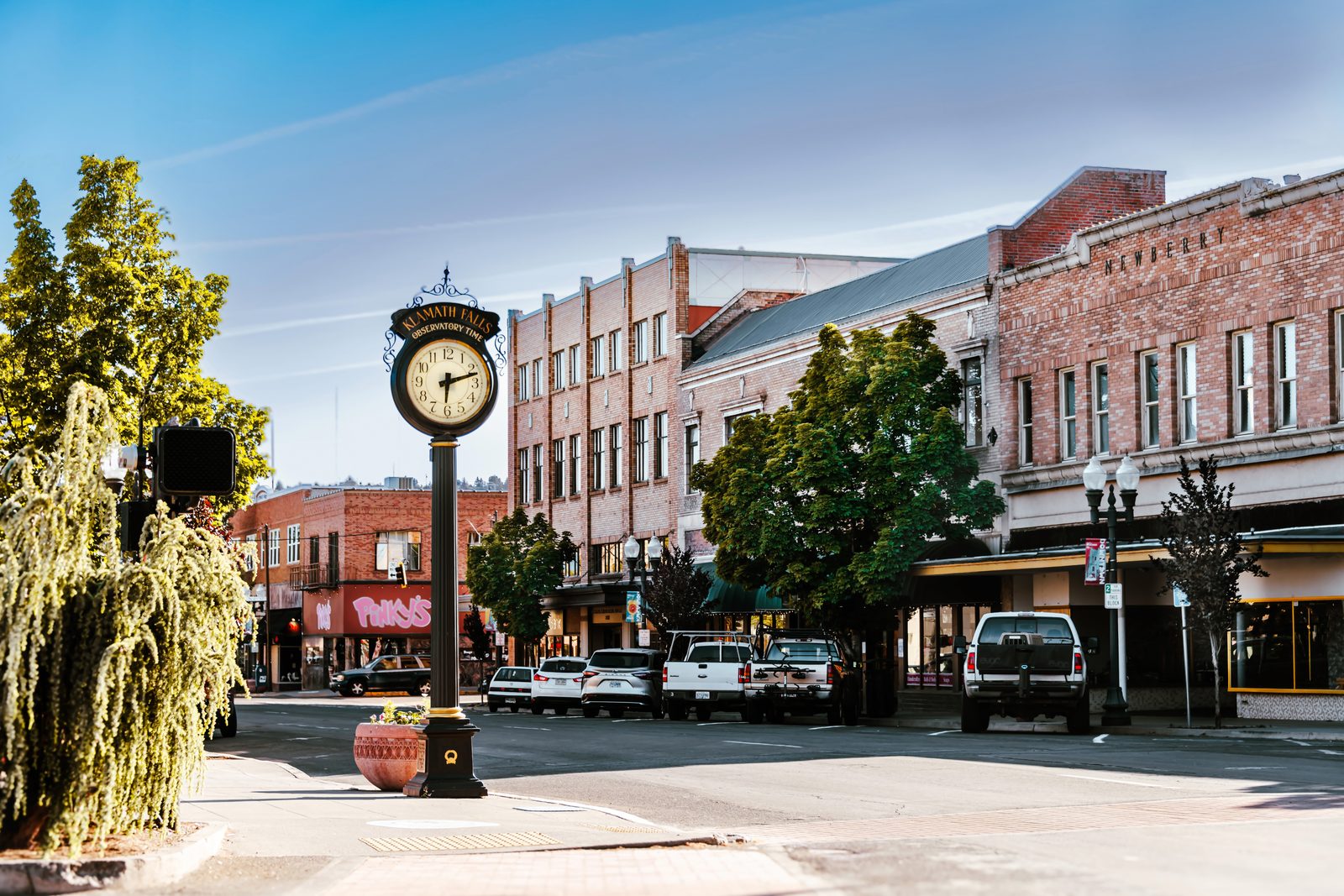
And at the Commons — that fountain where the kids are splashing — the Sky Lakes Board bought the land and gave the space to the city as a gift, turning a bare lot into the town's living room. No fundraising campaign. No sign.
Cauble is scrupulous about which of these he claims. Most were running before he arrived. "I don't get to take credit for those programs," he says.
The Pipeline He Did Start
There is one exception, and it is the initiative the AHA singled out as a surprise: career and technical education, and the paid student-ambassador program that puts Klamath Falls high schoolers inside the hospital.
It started as a workforce pipeline, and he is candid that Sky Lakes needed one. What has come back is larger. "Now they're graduating from high school and they see a different world of opportunity," he says. "Now they see a pathway forward." Students graduate at higher rates even when they never put on scrubs — the benefit outruns the staffing plan.
Alexis is what that looks like finished. A Henley High School graduate and former Sky Lakes ambassador, she is now a CNA at the hospital and a nursing student at OHSU. Ask what she looks forward to and the answer is not a job title. "I'm most excited about being able to care for people, like bring them that comfort and satisfaction of knowing I helped them and cared for them and they can move on about their life without worry."
Driscoll puts the program in the language of economics. "Ideally we're working to give people the opportunity to have high-wage health careers, which could lead to ending generational poverty," she says — "equal opportunity to all students, regardless of background." It is built to outlast its founders' budgets, with partnerships at Klamath Community College and Oregon Tech.
The $100,000
The prize came with a check — $100,000 — and true to form, Sky Lakes is giving it back to the community, not the balance sheet.
"This award, it really is about the community. It's not just Sky Lakes," Cauble says. "We want to give it back to the community and do something special that we can enjoy together as a community." Not, he is explicit, the operating budget.
Where it lands is still being worked out. The plan is to turn unused land into another public space. "We're working closely with the city, county, and reached out to ODOT to identify a piece of unused land we can transform," Driscoll says. "Ideally we'd go out to the community and ask them to contribute — whether that's with shovels — making it a community-impact project."
And because the Klamath Basin is 10,000 square miles and most of it is not Klamath Falls, the hospital goes out to it — a grant-funded mobile clinic, telemedicine behind it. Ask Cauble what "access" means in Lakeview or Chiloquin and he answers in gas money.
The Honest Part
None of this means the work is finished, and Driscoll is the first to say so. Youth vaping is climbing. Behavioral health remains a stubborn challenge. Housing is short for the families who need it most. "We still have a lot of work to do," she says. But she won't frame that as defeat. "What we've built proves our community can be a leader in community-health improvement regardless of our size. We're not waiting for someone else to solve our health problems — we are doing it together."
Cauble sets the clock even longer. "Impacting the health of a community is really a generational sort of an impact," he says.
Ask Driscoll to picture five years out and she doesn't reach for a statistic. "Klamath County would be a place people want to come live, work, learn and play," she says. "It is built for people." Then she catches herself, because she can already see it. "When I go out, it's not that different than what I describe right now."
The challenge she would hand the rest of us isn't clinical, it's civic. "It's okay to be proud of our town and our people," she says. "We can admit — yes, we have challenges. What town doesn't? But look what we're doing."
We asked both of them the same closing question: where's the best meal you've had in Klamath Falls? Cauble, the Kansas City transplant, dodged it and pointed at his own backyard. "I love barbecue. So I have quite a few smokers in my backyard. Maybe that's a safe political answer."
Driscoll grinned when she heard it. "He didn't tell me what time to come over, so I'm still waiting for the invitation."
Her own pick isn't a restaurant at all. It's Woodsy Kitchen, the local retail shop whose catering side has fed events all over Klamath Falls, Healthy Klamath's among them. "Which has been fantastic," she says.
Fitting, somehow, that the best meal in town turns out to be the one a local business quietly puts on the table at somebody else's event — and nobody's checking whose name is on the door.